Sunday, August 10, 2008

Siks Are Rad (or Ten Reasons I Would Marry a Pujabi Man in a Heartbeat)

Warning: The following post is politically incorrect and contains descriptions and opinions that objectify men in the worst possibly way. Unless you are in a good mood, fellas, you might want to skip over this particular entry.

Tall men? Awesome shoes? A temple covered in gold? Welcome to the Punjab girls. Hold on to your religious beliefs, it's gonna be a wild ride. I've had my fair share of come-ons and creepy encounters with Indian men while on this journey, enough to make me loath the idea of having to have a solo conversation with a man while here. But then I got to the Punjab.

  1. Until you've been here and seen it, you probably won't understand it. But trust me girls, there is nothing sexier than a man in a turban. Except, maybe, a man with a turban and a sword. Dead sexy girls. No joke. Why? I have no idea. Even when the turban is bright pink and three times the size of his head, a Sikh man manages to make that thing look manlier than chain mail in the middle ages. You think I'm joking but no, I'm totally serious. Punjabi + Turban = Dead Frigging Sexy.
  2. Altitude. True, I have spent the last few months in Tamil Nadu where the average height is around the level of my waist. But even in the states I find it very difficult to find men who are significantly taller than me. Not here though. Here, walking through the temple complex, I pass more men who are taller than me than men who are shorter by far and away. The other day I met a charming Sikh man with a black turban and a height of no less than seven feet in the temple. I usually say I'm married whenever I feel the situation is leaning toward awkward hit-on moment. But this time it was really, really, really hard to say yes when he asked me if I was married. Really hard. So hard that I'm pretty sure he saw through the lie the second it left my lips. He still asked for my number. Did I give it to him? No. But only because I drew upon superhuman amounts of self restraint.
  3. Devotion. Amritsar is home to the Golden Temple where the Guru Granth Sahib (Sikh's holy book of scripture) is housed, and this means that most of the Sikh men I meet here are devout worshipers, trying to live a good life. They wear the five symbols of Sikh devotion: the metal bracelet that symbolizes the eternal cycle of rebirths from which we all seek release, the long hair and uncut beard (wrapped in those fabulous turbans, see point one again just for the fun of it) which symbolize a harmony with the laws of nature and help with meditation, the small dagger at their side which, though dull, is meant to represent willingness to fight for the truth, the comb (hidden in the fantastic turban, repeat step #1 one more time, you know you want to) which is a symbol of cleanliness in all aspects of life, and the unseen but very interesting holy undergarments (sound familiar anyone?) which remind one to remain pure in life (again, ringing any bells?). No liquor, no meat. Living a pure religious life is a tough road for a Sikh. Is it any wonder that I find a man who tries to live up to those high standards devastatingly attractive????
  4. Interactions with families. I spent most of my time here people watching in the temple complex and have loved seeing more men carrying children than women carrying children. This is partially a reaction to the strict divide between men and women in Hinduism which has played such a role in my experience here. That divide does not exist for Sikhs. Men and women circumambulate the temple together, side by side. She doesn't walk one step behind him and he doesn't ignore the fact that she is struggling with three children. They walk together, and he carries his daughter or son. He is proud of his family, he loves them, he is a part of them. I took a photo of a large older man with an even larger white turban, bending down slightly as he walked so he could hold his granddaughter's hand and hear her speak while they walked together. You don't see that everywhere in India, but you see it here. Men who love their families. Again, dead sexy.
  5. The Dancing. You know in those Bollywood movies when, suddenly and completely without context, all the men start dancing together with these really fantastic athletic moves? Well, imagine you're just sitting at Pizza Hut with a few of your girlfriends, you know, a girls' night out. And you're half way through the second pizza when your waiter (who, by the way, is about 6'6” and absolutely gorgeous with an apron on his hips that proclaims “Full Punjabi”, which could refer to the Pizza but more likely to him) turns off the corny American music and announces that for your viewing pleasure he and all the other fantastic “Full Punjabi” waiters are going to dance for you. Suddenly the room is filled with the heavy beat of a Punjabi mix and a line of six men in Pizza Hut uniforms is performing those same fabulous Bollywood moves right there in the restaurant. Oh yes, that really happened to us. Don't you worry; we got a video of it.
  6. Weaponry. As previously mentioned, carrying a dagger is a part of everyday Sikh life. Now, that's pretty rad and, all don't get me wrong. What is even more rad, though, is the fact that even today an integral part of a Sikh wedding is when the groom arrives...on a horse...with a sword. Don't lie girls. You know deep down a part of you is still hoping for that “knight in shining armor” to show up. Well, maybe if you moved to the Punjab he would. Only he'd ditch the armor and get an even more attractive turban to go with his curving, beautiful, and very masculine sword. (Don't worry, mom. I am coming home anyway...I think.)
  7. Mostly, though, I think the real reason I find Sikh men so attractive is that they are secure in their masculinity. They know they are men. They don't need to be reassured of it everyday; they know it. And they don't need to make women feel like cheap trash in order to prove it to themselves. So, basically, if you marry a Sikh man you can guarantee that you won't have to spend your entire married life reassuring him that he is a man. He knows it, and you can therefore feel free to be a woman without fear that your femininity will threaten his masculine insecurities. Or, in other words, sorry LDS RMs. You've been upstaged. By a long shot. I hope we can still be friends. (Yes, I just broke up with the entire single, post mission, male LDS community. It's not you, it's me.)
  8. The shoes. No, not the ones the men wear. The ones that I wear. You know how Princess Jasmine has those lovely shoes with the curly toes? Well, add a little glitter and a lot more pizzazz and you have Punjabi shoes. Or rather, I have Punjabi shoes. Seven pairs of them. And if I opted to settle down here my love affair with north Indian footwear wouldn't have to end there, would it? So basically, I'm also breaking up with Payless.
  9. The pants. Along with her excellent taste in shoes, haven't you also envied Princess Jasmine her ability to wear huge puffy pants and get away with it? Yeah, me too. They are all the rage in women's fashion here, though. Various styles: smaller up on top and poofy at the bottom, flowing all the way down with a sort of layered look on the back side, smaller poof at the bottom with a fantastic matching shawl. They work with almost any figure, including the invert-o-bum I inherited from my grandfather. One more reason to marry a man who can keep me close to the shopping scene in Amritsar.
  10. This one would take a lot longer to fully describe than I can do justice to here, so if you really want to know you'll have to ask me about it when (if??) I go home. Punjabi man+turban+soldier's uniform+7'2” tall+Pakistani border closing ceremony= me coming as close as I ever will come to jumping a man.

And that's all I'm going to say about that.

Thursday, July 31, 2008

Me at the Golden Temple, head covered in respectful piety. Sikhs doing the walk around the temple, check out those turbans! It's enough to make Aladin jealous. And a shot of the temple itself, yes, it really is that pretty!

Buddha's favorite hang out, Bodhgaya.

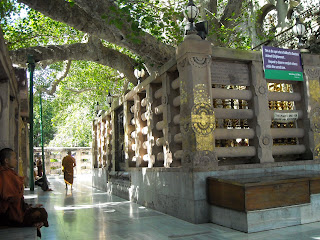
Buddha, Tibentan style. Every wall of this temple is covered in painted carvings about his life. And the bodhi tree under which buddha was enlightened, complete with Burmese monk deep in meditation on his way to enlightenment. Om baby om.
The bodhi tree

Varanasi, photographic evidence that I survived it.


a group of bathers fresh from mother Ganga, and a view of the holy river from my hotel balcony. the burning ghat is on the other side of that tower.

Monday, July 28, 2008

Where God Is, and Where God Isn't

A few thousand years ago there lived a prince named Siddhartha who sat down under a bodhy tree to meditate. Sometime later, under that same tree, he attained enlightenment and people started calling him Buddha. Maybe you've heard of him?

Anyway, a decendent of that bodhy tree still stands in the same plot of ground today, behind a temple dedicated to Buddha. And even though Buddhism is pretty much dead in India, it is still alive and well almost everywhere else in Asia. So there are monasteries from all those other countries here in this tiny town dedicated to Buddha's enlightement. That, I suppose, is why I am here: to learn something about Buddhism and meditation, about life and its purpose. About myself.

Someone once asked Michael where God is. His answer was “I dunno...everywhere?”. No. Wrong. God is not “everywhere”. God is in YOU. Or, at least that is what the Tibetan master told him. And when the master told him that, Michael had a flash back to when he was a five year old boy in the suburbs of LA and he fell down in the street. There was a moment, very short, when he was neither standing nor falling but just hanging in the air. And now Michael realized “Oh my gosh, nothing has changed.” He saw, in that strange experience, that there is some part of him that is unchanging, some small bit of awareness in him that is not just a reaction to the world around him. Something constant, something more real than the street onto which he fell. Something Divine.

And so, a few decades later, he is in India trying to understand that divine something that, even now, is unchanged within him. He has been searching in ashrams and meditation retreats in Nepal, India, and Tibet for about eighteen years now. He looks like it, too. He has one of those long, scraggly, mostly gray beards hanging off his face. His long hair is coiled into a bun at the point of his head (which, if we are honest, kind of makes him look like a small animal pooped up there). He wears all white, very simple, with a strand of wooden prayer beads around his neck. When I met him he was sitting next to the afore mentioned bodhy tree, legs crossed in 'lotus position', smiling at the universe in general.

Nearly twenty years in India is a long time. Four months in India is a long time, so I can hardly blame him for being a little “spacey” after eighteen years here. But I thought I would share a few of the things he told me as we sat together in the shade of that ancient temple and sacred tree, contemplating the meaning of life and who exactly was this Buddha figure

There is no “you” there is no “me”. Seeing a definition between self and other is the root of all suffering. We must eliminate suffering by eliminating the self.

When meditating, let your mind lose all distraction until you reach the center of awareness. The mind is like a monkey, continually jumping from branch to branch. The purpose of meditation is to let that all go and reach to real awareness, beyond self and time.

Let your heart shine within you. Let it radiate compassion until everyone around you can feel it and see it in you. Sometimes at night, you wake up and you can't sleep. Let your heart radiate compassion in those moments. Compassion is the expression of wisdom.

Some try to live their lives in avoidance, renouncing the world by not taking part in it. Others live through the world and renounce it by not becoming attached to it. The former will ultimately spend too much time dreaming of the world they have renounced. The later plays with fire, but at least they know what the fire is and what the fire isn't. They do not dream of fire.

Michael told me a lot of other things in the hour and a half we spent together. But these are the things which I liked or disliked the most. So, having given you his ideas, let me explain my ideas about them.

I am me, you are you. We are not the same consciousness, awareness, soul, brahma, call it what you will. And because I am not you, I cannot control you. Sometimes I cannot even control myself. And there is suffering. But there is also joy. I take the suffering with the joy. I take you with me. I take it all. And it hurts, but it's worth it. I cannot be empty, so I will be full.

My mind is a monkey, or an FM radio without an off switch. I spent an hour doing “zazen” meditation at the Japanese monastery here the other day, and never did achieve real quietness of mind despite the gongs, drums, and mystical chanting going on around me. I did manage to redecorate my hotel room in my mind, though. And I had a good long chat with the gold plated statue of Buddha in front of me about inflation in the US. But as far as real meditation goes, it was not a success. But then there was that time in Coimbatore:
Once about a month ago, I was just at the bus stop in Coimbatore, the city near the village we lived in for two months. Busy people all around me, buses coming and going with horns blaring the whole time. The ubiquitous smell of over ripe fruit and urine mingling in my nostrils. Women in sarees, college aged girls in salwars, and men in doties and western slacks passing in rapid blurry succession. I was alone, going home after a long day in the city. I sat on the corner of a tiled waiting bench, knowing it would be about half an hour until bus 96 came blaring into the fray, oozing people like a fresh wound and taking them in again just as fluidly. So I sat, and for no particular reason closed my eyes. I think I intended to say some kind of prayer about getting home safely or something, but before I had even formed the prayer in my head it happened. As soon as my lids closed on the scene around me I was surrounded by the Spirit. As though God had been waiting for me to pay just enough attention to Him, just enough peace in my mind and WHOOSH there He was. Not shouting, not warning, nothing urgent or mind blowing. Just quiet knowledge that He exists, that He is there, and that He is intimately aware of my every thought and feeling.
It happened again by the bodhy tree with Michael yesterday. He started talking about meditation and, trying to be obliging, I closed my eyes. And that was all it took for something to open up inside of me, like a direct line to Heavenly Father. Again it was not a warning, it was not a spiritual confirmation of anything Michael had said. It was just there, like God just couldn't resist talking to me now that I was in a quiet moment. Not because He had anything particularly pressing to tell me at that moment, but just because He could. That's all. I was quiet and still and listening and He was just...there. Like this weird wordless conversation “Hello Jenny. I'm here. I see you. I love you more than your mind can possibly understand and want you to be happier than your imagination can possibly comprehend right now. Just thought I'd say Hi.” and my response “uhhhhhhhh, Hi?”
So if that's meditation, sign me up.

Yes, let your heart shine within you. Compassion is lovely. But, rather than “shining your heart” when you can't sleep at night, DO SOMETHING COMPASSIONATE. You know, love someone, see something divine not just in yourself but in others as well, give something, see a need and fill it. Our capacity to love, and love deeply on a personal level is not an attachment that draws us further from God. Our capacity to love comes directly from God, and embracing that makes us more like Him, not less.

I neither play with fire, nor dream of fire. So...I'm neither a closet pyromaniac nor covered in third degree burns. Where does that put me?

Overall, I like Buddhism for its emphasis on finding out who you really are outside of your reactions to the world around you. I like the idea that I am more than the sum total of my fears and wants, my likes and dislikes. I also like meditation, on a strange level, and I fully intend to work on that skill. I don't want Heavenly Father to have to raise His voice at all to get my attention, so I figure I'll give Him more quiet time. You know, I'll just shut up for an hour or two everyday and see if He has anything to fill the silence with. What I don't like about Buddhism has mostly to do with its view of relationships between people. And that's okay. I don't have to like every aspect of it. Which is another thing I've learned here: I don't have to like it.

Saturday, July 19, 2008

Nightmare

You know how when you think of India, only a part of you wants to go there? Well, imagine all the worst ideas you have about India. Think of all the reasons that, when you think of me here, you breath a sigh of relief and think "better her than me!". Okay, now times it by five.
Ladies and gentlemen, I give you Varanasi.
Ironically, Varanasi (or Benares, as it used to be called) is the holiest city in Hinduism. The city of Shiva with dozens of holy ghats descending into the magical, mystical, mythical River Ganga. Unfortunately, that river is also the dumping ground for 30 or more sewers, so basically it has a content of 1.5 million faecal bacteria for every 100ml of water. Oh, and did I mention the smell?
We all know that cows are holy creatures in India, and no where is that more apparent than in Varanasi where in the middle of a busy intersection with traffic whizzing in all directions a single mournful cow stands unmolested, calmly defecating as traffic swerves around it. Heidi has been clipped by rickshaws twice in two days now. But do the cows get hit? No, oh no. Not the cows. They don't even get honked at.
Getting to our hotel is like walking into a Tim Burton set, except there is no way out. This city is supposedly the oldest living city on earth, so it is not surprising that the roads closest to the river are narrow, winding, and utterly filthy. Vehicles are not allowed in this part of the city, and even if they were how they would fit down these alleys I don't know. But our little Hotel boasts riverside views, so we wander the darkened, pooh lined alleys to get here and back everyday. Since there are no maps which show all the winding alleys of old Varanasi we are left to our own navigational devices every time we step out the door. One moment you think you are walking away from the river, you feel sure that the next turn will bring you to a main road, and the next thing you know you are staring at yet another curving, smelly, dangerous alley that is just as likely to lead you back where you started as to get you out of here.
The sky is always overcast here. It lends this sort of eerie feeling to an already freaky city. It also means that the humidity is almost more than humanly bearable. The ground is wet, muddy, slick where old cobblestones have not been covered in mud, cowdung, or...other things. And because I know the statistics of the river, I'm terrified of all water here, imagining everything is covered in the same 1.5 million faecal bacteria.
To be fair, our hotel is the nicest one we've yet stayed in. Clean, well run, and with those famed "riverside views". I took advantage of the view the first day, and that was enough for me. Little boys swimming naked in the river, old men with shaved heads waist deep in devotion, monks chanting as they washed in the holy waters. Then I saw some of them gargle it. And even now, I wretch just to think of it.
Scindhia Ghat, where our hotel is located, is right next to one of the burning ghats. There are two such ghats where devout Hindus who were lucky enough to die in the city of Shiva are cremated and flung into the waiting arms of their "Great Mother" the Ganga. This means that continually, day and night, if I open my door I can smell the bonfires of human flesh.
If you die in Varanasi, according to Hindu belief, you will be released from the cycle of rebirth immediately. A shop owner with whom I spoke yesterday explained it to me like this: "As you live you have good things and bad things. These things stay with you and when you die God will ask you about it and punish you with a new birth. But if you die here, you go to heaven and God will not ask you any questions." And I guess I can see that. I mean, living in this city is probably more than enough punishment itself without any new births.
I wish I could tell you I've learned something deep and transcendent here, something about the relationship between life and death or human potential and frailty. The truth is, thus far, I have learned one thing.
When in Varanasi, try not to look down.

Thursday, July 17, 2008

Sravanabelagola, Jainism

These are all from Sravanabelagola, an ancient Jain pilgrimage site. Elephants walking around the base of a temple. Me walking the hall of a 2000+ year old temple, a Thirtankara statue in naked meditation, and me in slightly more modest meditation at the top of "big hill" where we climbed barefoot to see the temples. See the next post for what I learned here.